Most retreat leaders do not start with a search for a galapagos giant tortoise hotel. They start with a feeling. They want a place that quiets the group within a day, removes the usual logistics burden, and offers something participants cannot replicate on a standard beach retreat. In the Galapagos, that difference often comes down to where the land still feels alive – where giant tortoises move through the highlands, birdsong carries at dawn, and the schedule can hold both deep rest and real discovery.
For yoga and Pilates teachers planning a hosted week, the phrase matters because it points to something more specific than wildlife-themed lodging. A true retreat setting in the Galapagos should place your group inside the landscape, not just near it. That means space to practice, rooms that feel private and restorative, meals that support the rhythm of the retreat, and excursions designed with enough structure to feel easy and enough wonder to feel memorable.
What a galapagos giant tortoise hotel should really offer
The most compelling properties in the islands are not the biggest. For retreat leaders, smaller often works better. A ten-room boutique hotel can hold the intimacy a group needs, especially when everyone is arriving for a shared purpose. You are not competing with wedding parties, day visitors, or a crowded activity calendar. The week can take on its own shape.
That matters more in the Galapagos than in many destinations because logistics here are not casual. Airport transfers, island timing, meal planning, and excursion coordination all affect the guest experience. If you are bringing a group from the US or Canada, your participants are usually looking for confidence as much as inspiration. They want to know the week will flow well from arrival to departure.
A retreat-ready property should bundle the essentials into a coherent package. Accommodation, yoga shala access, meals, transport, and guided outings should feel designed together rather than added on one by one. When those elements are handled by one attentive team, the retreat leader is free to lead.
Why wildlife access changes the retreat experience
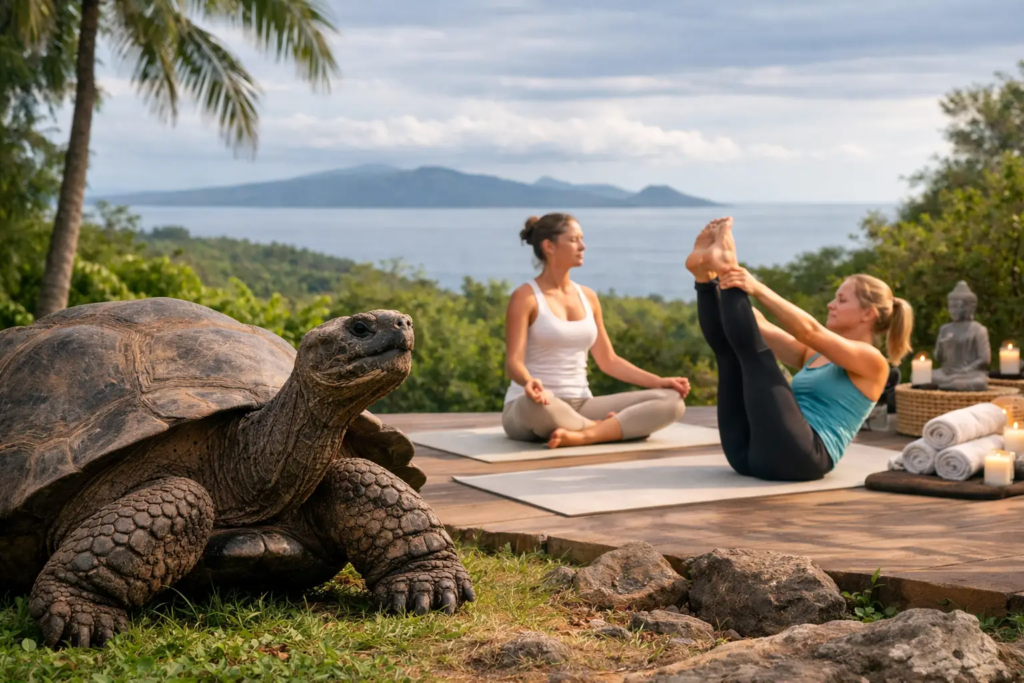
There is a major difference between seeing wildlife on a scheduled outing and waking up in a place where wildlife is part of the day. Giant tortoises have a way of slowing a room without asking for attention. They move with a kind of ancient confidence that subtly shifts the pace around them. For retreat guests, especially those coming from overstimulated urban lives, that encounter can be as grounding as a long practice.
This is where the idea of a galapagos giant tortoise hotel becomes powerful for wellness travel. It is not novelty. It is context. A morning session in the shala lands differently when the surrounding landscape is a habitat rather than a backdrop. The same goes for breakfast after class, an afternoon walk through the highlands, or a quiet evening listening to frogs and night birds under a dark sky.
There is also a practical advantage. If your property sits in the highlands with direct access to nature, your group does not need to spend every restorative moment in transit. You can combine wildlife encounters with rest, rather than choosing one over the other.
The retreat leader’s real question: Can I host well here?
For teachers, beauty alone is never enough. The place has to support the group dynamic and the work of holding space. That starts with the practice environment. A dedicated yoga studio for small groups, with enough room for movement and stillness, is far more useful than a makeshift terrace setup that looks good in photos but creates compromises in weather, privacy, or acoustics.
Lodging matters just as much. Ensuite rooms, a sense of privacy, and generous natural surroundings help participants regulate and settle in. Shared energy is part of retreat life, but so is retreat from the group. A small hotel that understands this balance gives people room to absorb the experience.
Then there is food. For weeklong yoga and Pilates retreats, meals need to feel nourishing and easy, not performative. Home-style dining often serves this format better than a large resort restaurant because it creates familiarity. People return from an excursion, gather, exhale, and reconnect over food that feels thoughtful and grounded.
Fully inclusive or semi-inclusive? It depends on your group
One of the smartest ways to plan a Galapagos retreat is to choose the package structure before you worry about finer details. For many teachers, fully inclusive works best. It simplifies communication, clarifies pricing, and reduces decision fatigue for guests who are already making a meaningful travel investment.
That said, semi-inclusive packages have their place. If your audience includes experienced travelers who value a little more flexibility, a semi-inclusive format can feel appealing. They still benefit from coordinated lodging, practice space, core meals, transfers, and selected experiences, but retain room for personal choices.
The trade-off is straightforward. Fully inclusive retreats are easier to market and easier to run. Semi-inclusive retreats can broaden appeal, but they ask for clearer expectations and stronger guest communication. Neither is better in every case. The right choice depends on how hands-on you want the week to feel and how much freedom your participants truly want.
A better rhythm for a Galapagos retreat week
The Galapagos is not a place to overschedule. The most successful retreat itineraries usually alternate movement, nature, and unhurried integration. Morning practice, breakfast, and a guided excursion often create the backbone of the day. The afternoon may hold rest, a second class, a highland walk, or time to simply take in the landscape.
This slower architecture is not a luxury. It is what allows the destination to work on people. If every day is packed from dawn to dinner, the islands become another checklist. If the schedule is too loose, guests may feel they are missing something in a place they may visit only once.
A well-designed package solves that tension. It offers enough guided activity to reveal the richness of the islands – snorkeling, wildlife encounters, day trips, highland exploration – while preserving the quiet that retreat guests came for in the first place.
Boutique scale is not a minor detail
Large properties can offer convenience, but they often dilute the very qualities retreat leaders are trying to protect. In the Galapagos, boutique scale can mean owner-led hospitality, direct communication, and a level of care that guests notice immediately. It can also mean fewer distractions, more flexibility, and a stronger sense of being welcomed rather than processed.
For group leaders, this has operational value. Questions get answered faster. Dietary preferences are easier to accommodate. Timing adjustments can be handled with more grace. The week feels held.
At a place like Semilla Verde, that scale also supports something harder to measure but easy to feel: authenticity. A retreat does not unfold in an anonymous hospitality machine. It unfolds in a lived landscape with forest access, a coffee plantation setting, panoramic views, and giant tortoises moving through the property as they have long before guests arrived.
Stewardship matters to your guests
Wellness travelers are increasingly alert to the contradictions of travel. They want extraordinary places, but they also care how those places are treated. In the Galapagos, that awareness is essential. A retreat property should not only benefit from the environment around it. It should contribute to its care.
That is why sustainability and endemic reforestation are not side notes. They are part of the retreat story. For many guests, especially eco-conscious professionals and experienced travelers, the emotional value of the trip deepens when they sense the property is acting as a steward, not just a seller of scenery.
This does not require moralizing language or polished eco branding. It shows up in scale, land use, hospitality choices, and the way the experience is framed. The best hosts understand that reverence for the islands should shape the guest experience from the first transfer to the final morning practice.
If you are searching for a galapagos giant tortoise hotel, look beyond the phrase itself. Ask whether the property can carry a retreat, whether the landscape is truly present in the stay, and whether your guests will leave feeling not just entertained but restored. In the Galapagos, that difference is everything.